

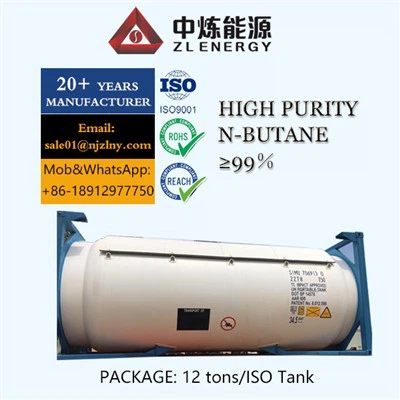
N-Butane (ODP=0, GWP≈3) is a preferred environmentally friendly blowing agent for replacing HCFC-141b. It offers an extremely low thermal conductivity (approximately 13.5 mW/m·K) and cost advantages, but has the inherent drawback of being flammable and explosive (explosion limits 1.9%-8.5%), requiring explosion-proof retrofitting according to GB 50058. As a refrigerant, its boiling point (-0.5°C) limits its use to an auxiliary blending agent for refrigerants such as R290. The key to successful substitution lies in the deep purification capability of manufacturers like Nanjing ZL Energy to control sulfur and olefin impurities, thereby avoiding catalyst poisoning.

Hardcore Advantages, Disadvantages, and Selection Guide for n-Butane as a Blowing Agent and Refrigerant
In recent years, the polyurethane industry and household appliance manufacturers have been repeatedly tormented by the same question: with the phase-out deadline for HCFC-141b approaching, what should be used as a replacement? Among the various alternatives available, n-Butane has successfully carved out a path for itself by virtue of its near-perfect environmental data and high cost-effectiveness. However, as a flammable gas, n-Butane has never been a "plug-and-play" universal solution. Today, setting aside theory, let's take a clear look at the cards n-Butane holds as a blowing agent and refrigerant from the perspective of practical factory operations.
Core Advantages and Disadvantages of n-Butane as a Substitute for Traditional Blowing Agents
n-Butane, as a blowing agent, offers ultimate environmental compliance and low cost, but at the price of requiring stringent explosion-proof upgrades to the entire foam production line.
Formulators know that the most direct sensation when introducing n-Butane into a polyurethane system is the improvement in the foam's thermal insulation performance. Because its molecular structure endows it with a thermal conductivity even lower than that of cyclopentane. This means that the insulation layer of a refrigerator can be made thinner, freeing up more internal volume space. At the same time, compared to the persistently high-cost HFCs (e.g., 245fa) or LBA, n-Butane is essentially a byproduct of the chemical industry, offering an overwhelming cost advantage.
However, the equation is not one-sided. With a boiling point of -0.5°C, n-Butane vaporizes easily in high-temperature workshops during summer, leading to poorer solubility of the blowing agent in the polyol blend and easily coarsening the cell structure. More concerning is the safety issue. It is a Class A hazardous chemical; a leak encountering static electricity would be a disaster.
To clearly position n-Butane, let's have a hardcore comparison with the current mainstream alternatives on the market:
| Blowing Agent Type | ODP (Ozone Depletion Potential) | GWP (Global Warming Potential) | Boiling Point (°C) | Thermal Conductivity (mW/m·K, 25°C) | Comprehensive Cost Assessment | Safety/Process Pain Points |
|---|---|---|---|---|---|---|
| HCFC-141b (being phased out) | 0.11 | 725 | 32.0 | 10.0 | Extremely low (production banned) | Depletes ozone layer; already banned by national regulations |
| n-Butane (Hydrocarbon) | 0 | ~3 | -0.5 | ~13.5 | Extremely low | Extremely flammable; requires high-pressure storage/transport and explosion-proof workshops in summer |
| Cyclopentane (Hydrocarbon) | 0 | ~11 | 49.3 | 14.5 | Low | Flammable; poor flowability; prone to mold sticking in refrigerator demolding |
| HFC-245fa (Fluorocarbon) | 0 | 1030 | 15.3 | 12.5 | Extremely high | High-GWP substance; faces risk of secondary phase-out in the future |
Application Limitations and Breakthroughs of n-Butane in the Refrigerant Field
n-Butane is rarely used alone as a large-scale commercial refrigerant. At present, its main role is as a blending agent to fine-tune the performance of systems using R290 (propane) or isobutane.
If you ask R&D engineers working on air conditioners or freezers, they most likely would not recommend pure n-Butane as a refrigerant. The reason is simple: the boiling point of n-Butane (-0.5°C) is relatively high among hydrocarbon refrigerants. Once the ambient temperature exceeds 35°C in summer, the heat dissipation pressure on the condenser soars, the compressor load becomes extremely high, and there is even a risk of shutdown and burnout.
However, the value of n-Butane becomes apparent in certain specific light commercial refrigeration equipment or deep cold chains. Blending it in a certain proportion (e.g., 10%-20%) with R290 can effectively lower the excessively low evaporation temperature of pure R290, improve the compressor's oil return characteristics, and keep the overall mixture's GWP value at an extremely low level. This "supporting role" substitution solution is currently the most pragmatic use of n-Butane in the refrigeration sector.
Safety Red Lines and National Standard Requirements for n-Butane Foaming and Refrigeration
The hard prerequisite for using n-Butane is compliance with national explosion-proof regulations such as GB 50058. The explosion-proof rating of electrical equipment in the workshop and the ventilation system must meet the standards, with no room for negotiation.
Many small factories want to use n-Butane to reduce costs, but their plans are rejected by safety supervision authorities because they fail to address this safety hurdle. n-Butane has an explosion limit range of 1.9%–8.5%, which is not only wide but also has an extremely low minimum ignition energy (only 0.25 mJ, which can be ignited by human static electricity).
According to the "Code for Fire Protection Design of Buildings" (GB 50016) and the "Code for Design of Electrical Installations in Explosive Atmospheres" (GB 50058), the n-Butane injection area and foaming area must be strictly classified as Zone 1 or Zone 2 explosive gas atmospheres. This means:
All motors, lighting, and sockets must have an explosion-proof rating of Ex d IIB T4 or higher.
Floors must be treated with anti-static measures.
Highly sensitive combustible gas alarms must be installed at the workshop ceiling, interlocked with explosion-proof emergency exhaust fans (with air changes typically required to be ≥20 times per hour).
This capital investment in explosion-proof retrofitting often accounts for over 70% of the total cost of the entire substitution solution.
Why the Source n-Butane Manufacturer Determines the Success or Failure of the Substitution Solution
The key to successfully implementing a substitution solution lies, in essence, in the deep purification process and batch stability of the n-Butane manufacturer. Failure to control impurities will directly lead to a sharp increase in foam scrap rates.
Many companies have encountered pitfalls when adopting n-Butane substitution, initially suspecting formulation problems, only to discover that the raw material gas was impure. If n-Butane comes directly from a refinery's catalytic cracking unit, it often contains trace amounts of butadiene, sulfides, and even moisture.
In polyurethane foaming, even sulfur levels of just a few ppm in n-Butane can "poison" amine catalysts, causing a significant prolongation of the cream time, and the foam may not even rise. Meanwhile, olefin impurities in high-pressure refrigeration systems are very prone to polymerization at the compressor's high-temperature discharge end, forming carbon deposits that jam valves.
Therefore, a truly competent n-Butane manufacturer sells not just gas, but "consistency." A source manufacturer with the capability for precise distillation columns and full-component gas chromatography (GC) analysis, such as Nanjing ZL Energy, can commit to stabilizing n-Butane purity above 99.5% and controlling total sulfur below 1 ppm. In a systems engineering with such a low tolerance for error as the 141b phase-out, choosing a n-Butane manufacturer that can provide a stable, high-purity supply is paramount.


